
You’ve found the perfect queen mattress, but when the bed frame arrives, it won’t fit through your bedroom door. Or worse—it crams your room into an unusable space. This happens because average queen bed frame dimensions differ significantly from the mattress itself, and manufacturers rarely highlight these critical measurements. A standard queen mattress is 60″ x 80″, but frames typically extend 2-6 inches beyond these dimensions on all sides. Getting this wrong turns your sanctuary into a cluttered maze.
Understanding these hidden size variations isn’t just about avoiding shipping disasters—it’s the key to optimizing bedroom flow, ensuring comfortable movement, and preventing costly returns. With 68% of homeowners reporting bed frame sizing issues during furniture purchases (per industry surveys), this guide cuts through the confusion. We’ll decode exact external measurements for every frame style, reveal how materials impact sizing, and give you a step-by-step room measurement system. By the end, you’ll confidently select a frame that fits your space and your lifestyle.
Why Queen Bed Frame Dimensions Differ From Mattress Size
Your queen mattress measures exactly 60″ wide by 80″ long—but the frame holding it is intentionally larger. This isn’t a mistake; it’s structural necessity. Frames require extra width (62″-65″) and length (82″-86″) to accommodate side rails, headboard attachments, and expansion gaps for humidity changes. Without this 1″-3″ buffer per side, wood could warp or metal rails might pinch the mattress. Crucially, the internal opening where your mattress sits remains precisely 60″ x 80″ to prevent slippage.
Watch for these hidden size traps:
– Headboard overhang: Most add 1″-4″ beyond the mattress edge, eating into wall space
– Rail thickness: Metal frames use slimmer 1.5″ rails versus wood’s 3″ bulk
– Mattress expansion: Foam mattresses swell up to ½” in humidity, requiring clearance
Ignoring these can leave you with a frame that technically fits your room but blocks outlets, closet doors, or nightstand placement. Always request the frame’s external dimensions—not just “fits queen mattress” claims.
Standard Queen Frame Measurements: Width, Length, and Height
The average queen bed frame dimensions span 62″-65″ wide by 82″-86″ long externally, with heights ranging from 8″ (ultra-low platform) to 14″ (standard storage-ready). But these numbers hide critical nuances:
- Width: Metal frames hover near 62″ while upholstered styles hit 65″+ due to padding
- Length: Expect 82″-84″ for minimalist platforms, but sleigh beds stretch to 88″+
- Height: Low-profile frames sit at 8″-10″, but storage drawers push heights to 24″+
- Under-bed clearance: Only 4″-6″ on basic frames versus 12″+ for storage access
Pro Tip: Measure your ceiling height before choosing tall headboards. A 60″-tall canopy frame plus a 12″-thick mattress leaves just 12″ under an 8-foot ceiling—dangerously close to ceiling fans. Always subtract your mattress thickness from ceiling height when checking clearances.
How Material Choice Impacts Frame Size
Wood frames typically add 1.5″-3″ more width than metal equivalents due to thicker rails. A solid oak platform bed might measure 64.5″ wide versus a steel frame’s 62.5″. Upholstered beds? They’re the biggest culprits—thick padding swallows 2″-4″ per side, turning a 60″ mattress space into a 66″-wide frame. If your room is tight, opt for metal: its slim tubing saves crucial inches without sacrificing support.
Platform Bed Frame Dimensions: Low-Profile Queen Sizing

Modern platform beds deliver clean lines but demand precise spatial planning. The average queen platform frame measures 63.5″ wide x 83.5″ long externally with a 7″-10″ height—just 1.5″-2″ beyond the mattress on all sides. However, integrated slats often require 1″-2″ extra width for expansion gaps, especially in humidity-prone climates.
Critical measurement checklist:
– Confirm internal dimensions are 60.25″ x 80.25″ (allows for mattress growth)
– Verify leg placement: Center legs can reduce usable under-bed space by 4″
– Check headboard compatibility: Some require 36″+ wall clearance
Avoid this common mistake: Assuming low height means easy fitting. Platform beds often ship in bulky flat-pack crates. Measure your stairwell width—those 63.5″ frames need 66″ clearance for safe maneuvering.
Storage Bed Frame Dimensions: When Drawers Add Bulk
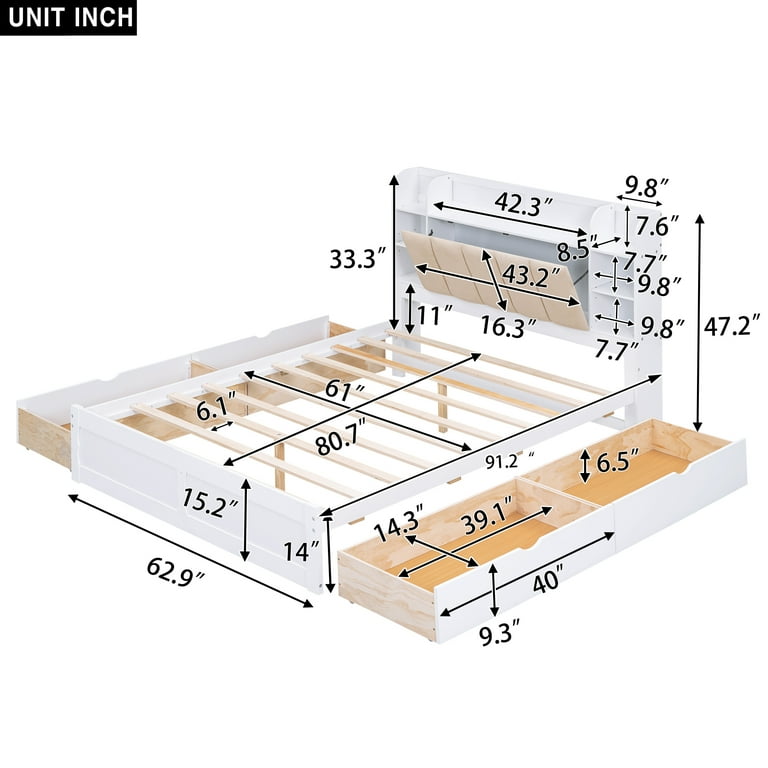
Storage beds solve small-space dilemmas but introduce major sizing challenges. The average queen storage frame spans 64″-66″ wide and 84″-86″ long—2″-4″ wider than standard frames—with heights jumping to 20″-30″ to accommodate drawers. That extra 4″ width might seem minor, but it’s the difference between fitting nightstands or cramming them against walls.
Drawer Clearance Requirements
- Side drawers: Add 1.5″-2″ per side beyond mattress width
- Front drawers: Require 12″-18″ pull-out space at the foot of the bed
- Lift-top mechanisms: Need 8″-10″ clearance above the frame for full access
If your room is 10′ x 10′, prioritize shallow drawers (14″-16″ depth) over deep storage (18″+). Deep drawers eat into walking space, forcing you to choose between storage access and door swing clearance.
Four-Poster and Canopy Bed Sizing: Accounting for Posts and Height
Grand four-poster and canopy beds transform bedrooms but create significant spatial demands. The average queen four-poster frame measures 70″+ wide by 90″+ long—up to 10″ beyond the mattress on all sides—with heights exceeding 90″ (7.5 feet). Those elegant posts aren’t just decorative; they require 6″-12″ clearance from walls to prevent damage during assembly.
Avoid these installation pitfalls:
– Ceiling collisions: Measure from floor to fixture before ordering. Canopy frames often sit 84″-96″ tall
– Doorway clearance: Disassembled posts may exceed 80″ in length—check hallways
– Foot traffic: Allow 36″ minimum clearance around the entire frame (not just sides)
Pro Tip: For rooms under 12′ x 12′, choose “low-poster” designs where posts attach below the mattress line. These add only 2″-4″ to external dimensions versus traditional floor-to-ceiling posts.
Sleigh Bed Frame Measurements: The Curved Footboard Effect

Sleigh beds’ signature curved footboards create deceptive sizing issues. While the headboard aligns with standard dimensions, the footboard often extends 6″-12″ beyond the 80″ mattress length. This pushes the average queen sleigh frame to 86″-92″ long—meaning you’ll need 24″ clearance at the foot (not 12″) to avoid bumping into dressers or walls.
Critical fit considerations:
– Measure from the outermost curve of the footboard, not the mattress edge
– Allow extra width: Carved designs add 1″-3″ per side versus flat-panel beds
– Check turning radius: The curved shape requires 48″+ clearance for assembly
If your room has a closet near the bed’s foot, choose a sleigh bed with a recessed footboard design. These stay within 84″-86″ lengths by tucking curves inward.
Metal vs. Wooden Frame Size Differences: Slim Profiles vs. Sturdy Builds
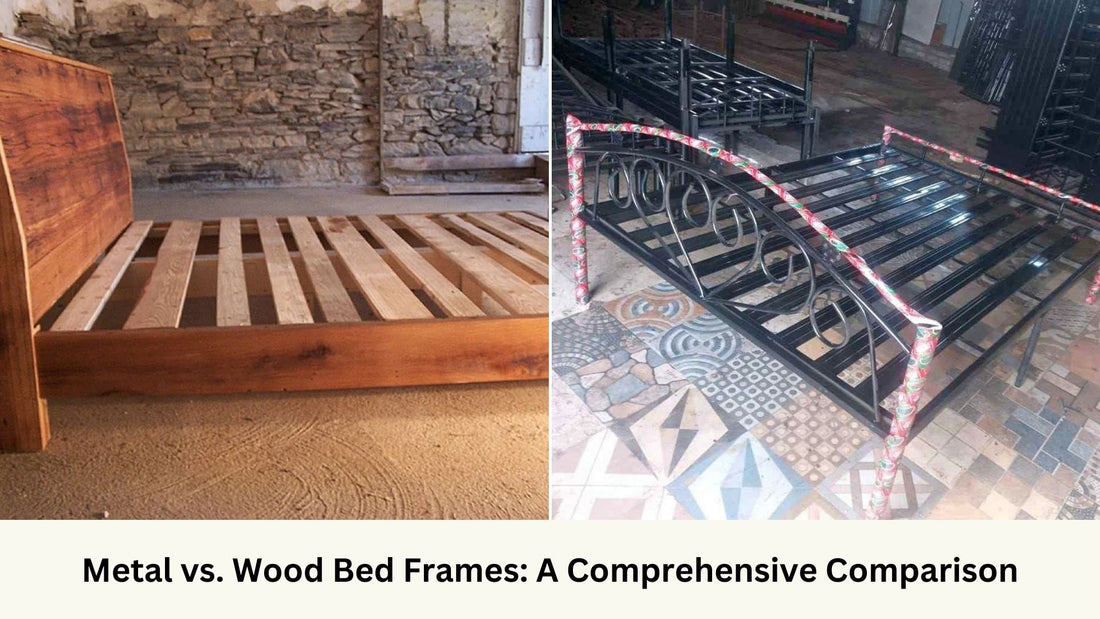
Material choice directly impacts your queen bed’s spatial footprint. Metal frames typically measure 62″-63″ wide—up to 3″ narrower than wooden equivalents—thanks to their 1.5″-2″ tubular rails. Wooden frames, with their 2.5″-3″ solid rails, often hit 64″-65″ wide. But don’t assume metal always wins for tight spaces:
- Metal advantage: Slimmer profile (saves 1″-2″ per side) and lighter weight for easier maneuvering
- Wood advantage: Sturdier construction allows narrower center supports (saves 2″ under-bed depth)
- Upholstered trap: Fabric-wrapped wood frames add 2″-4″ total width versus bare wood
For apartments with narrow stairwells, prioritize knock-down metal frames. Their modular design needs just 36″ clearance for assembly versus 48″+ for one-piece wooden frames.
How to Measure Your Room for a Queen Bed Frame
Skip this step, and you’ll battle furniture return fees. Follow this foolproof system:
-
Map your room’s “no-go zones”:
– Mark outlets, radiators, and closet doors with painter’s tape
– Note permanent fixtures (e.g., 18″ from wall to closet rod) -
Calculate traffic flow:
– Main pathways need 36″ clearance (not 24″ minimums)
– Secondary paths (e.g., to bathroom) require 24″ -
Test-fit with tape:
– Lay tape for the frame’s external dimensions (65″ x 86″ worst-case)
– Include headboard depth (add 4″-12″ beyond frame)
– Walk the path—you’ll instantly see clearance issues
Never skip this: Measure doorways and hallway turns. A 30″-wide bedroom door blocks 64″-wide frames unless disassembled.
Headboard Height Verification
Stand a ladder against your wall and measure from floor to ceiling fixture. Subtract your mattress height (typically 10″-14″). If the result is under 18″, skip tall headboards—opt for wall-mounted designs that float above the mattress.
Minimum Room Size Requirements for Queen Beds: Avoiding a Cramped Space
A 10′ x 10′ room is the absolute minimum for a queen bed, but it creates a cramped, dysfunctional space. Here’s the reality:
- 10′ x 10′ room: Forces nightstands against walls, blocks closet access, and eliminates foot clearance
- 12′ x 12′ room: Allows 30″ walking space on three sides and functional nightstands
- 14′ x 14’+ room: Permits seating areas and dual nightstands with 24″ clearance
Critical spacing rules:
– 36″ clearance on primary access side (e.g., hallway side)
– 24″ clearance on secondary sides (e.g., closet side)
– 12″ minimum at foot for door swing clearance
If your room is under 12′ x 12′, choose a platform bed with integrated nightstand shelves. These eliminate the need for floor-standing nightstands, saving 18″-24″ of width.
Pro Tips for Choosing the Perfect Queen Frame Fit
Prioritize these often-overlooked factors:
- Assembly clearance: Knock-down frames need 3′ clearance on all sides during setup. Verify room dimensions before purchase.
- Vertical space planning: Tall mattresses (14″+) on storage frames can exceed 40″ total height—check under-bed storage access.
- International variations: UK/EU frames run 2″-4″ narrower. Confirm measurements if ordering overseas.
- Weight distribution: Center supports reduce usable width by 2″-3″. For heavy mattresses, ensure the frame’s internal width is 60.5″+.
Red flag phrases to avoid:
– “Fits standard queen” (ignores frame expansion)
– “Compact design” (unverified claims)
– “Easy assembly” (without clearance specs)
Always demand a dimension diagram—not just listed measurements—from the seller. Reputable brands provide CAD-style visuals showing external vs. internal sizing.
Key Takeaways for Your Queen Bed Frame Purchase
Choosing the right average queen bed frame dimensions prevents costly spatial mistakes. Remember:
– Frames are always larger than mattresses—expect 62″-65″ wide x 82″-86″ long externally
– Storage and upholstered beds add the most bulk (prioritize metal for tight rooms)
– Measure your room and pathways with painter’s tape before buying
– 12′ x 12′ is the true minimum room size for functional queen bed placement
Double-check manufacturer specs against your space using the tape-measure method—it takes 10 minutes but saves hundreds in return fees. For next steps, download our free Queen Bed Frame Sizing Checklist (includes international conversions and clearance calculators) to ensure your dream bed fits your reality. Your bedroom’s flow—and your peace of mind—depends on these inches.


