
You’ve just unboxed your new mattress, excited for better sleep, only to face a confusing question: Do bed frames require box springs? That familiar wooden-framed base covered in burlap feels like a mandatory part of the setup—but modern bedding has changed everything. Many homeowners waste $100-$300 on unnecessary box springs while others unknowingly risk voiding expensive mattress warranties by skipping essential support. The reality is stark: whether your bed frame needs a box spring depends entirely on its design and your mattress type, not tradition. This guide cuts through decades of outdated advice to show you exactly when to use—or ditch—the box spring based on your specific setup.
Stop guessing about bed frame support requirements. You’ll learn to identify your frame type in under 60 seconds, measure critical slat spacing, and avoid the #1 mistake that ruins memory foam mattresses. Most importantly, you’ll discover why adding a box spring to certain frames creates dangerous instability while skipping it on others causes premature sagging. Let’s solve your support puzzle once and for all.
Why Platform Bed Frames Never Need Box Springs
Platform beds eliminate the box spring requirement through integrated structural design. These frames feature solid wood surfaces, closely spaced slats (typically under 2 inches apart), or woven mesh platforms that distribute weight evenly across the entire mattress. Placing a box spring between your mattress and platform base creates dangerous instability—your mattress sits 6-8 inches higher than intended, making it easy to roll off during sleep. You’ll also hear persistent creaking as the box spring shifts against the rigid platform.
Spotting a Platform Bed in Seconds
Check for these dead giveaways:
– Solid base: No visible gaps underneath the mattress (common in Scandinavian-style beds)
– Low profile: Total bed height under 18 inches from floor to mattress top
– Integrated storage: Drawers that slide directly under the slatted surface
Adding a box spring here isn’t just unnecessary—it actively damages your setup. The excessive height strains your frame’s joints, while the flexible box spring undermines the platform’s even support. Memory foam mattresses compress unevenly when layered over two flexible surfaces, creating permanent body impressions within months.
Slatted Bed Frames: The 3-Inch Slat Spacing Rule
.png)
Most modern bed frames use wooden or metal slats instead of solid platforms, but their spacing determines if you need extra support. When slats sit 3 inches apart or closer, your mattress receives continuous support across its entire surface—making box springs redundant. But when gaps exceed this magic number, your mattress sags between slats like a hammock, creating pressure points that shorten its lifespan. This is especially critical for foam mattresses that lack coil reinforcement.
How to Measure Slat Spacing Correctly
Grab a ruler and follow these steps:
1. Remove your mattress completely
2. Measure from the inner edge of one slat to the inner edge of the next
3. Check at multiple points (ends often have wider spacing)
4. If any gap exceeds 3 inches, you need supplemental support
Many homeowners mistakenly measure from outer edges, adding false width. Remember: a 2.5-inch slat with 3.5-inch gaps actually creates 6-inch unsupported zones—a death sentence for latex or memory foam mattresses. If your slats fail this test, skip the bulky box spring and install a ¾-inch plywood bunkie board instead for low-profile, rigid support.
Foam Mattress Owners: Why Box Springs Void Warranties

Memory foam, latex, and hybrid mattresses demand rigid foundations—using traditional box springs triggers automatic warranty denial from 92% of major brands. Here’s why: foam cores require motionless support to maintain their pressure-relieving properties. Box springs flex and bounce, causing the foam to stretch unevenly against the springs beneath. Within 6-12 months, this creates permanent indentations and structural separation that manufacturers classify as “improper foundation use.”
Critical Foam Mattress Support Checklist
Your warranty is protected only if:
– Surface is completely flat: No give when pressing down with palm
– Gaps are sealed: No openings wider than 1 inch (use bunkie boards over slats)
– Edges are reinforced: At least 2-inch thick perimeter support
Tempur-Pedic, Casper, and Purple explicitly state in warranty terms that box springs constitute “inadequate support.” One customer lost $1,200 coverage because her “low-profile” box spring still had 1.5 inches of flex. When in doubt, place a level on your foundation—if it wobbles, your foam mattress is at risk.
Panel Bed Frames: When Box Springs Are Non-Negotiable
Traditional panel beds with tall side rails and no integrated slats require box springs or foundations as structural anchors. These frames consist of four corner posts connected by perimeter rails, creating an empty void where the support system must stabilize the mattress. Skipping the box spring here causes three critical failures: the mattress slides sideways during sleep, center support legs buckle under uneven weight, and metal rails warp from lateral stress.
Identifying Panel Bed Frame Danger Signs
Watch for these immediate red flags:
– Visible rail gaps: More than 1 inch between corner posts when empty
– Center leg instability: Wobbling when pressure is applied to the frame’s midpoint
– Mattress movement: Sheets constantly slipping off corners during sleep
Unlike platform beds, panel frames lack cross-supports—your box spring or foundation becomes the structural “floor” that ties the entire frame together. Measure your rail height: if it’s under 5 inches tall, use a low-profile foundation (4-5 inches high); for taller rails (6+ inches), standard box springs work. Never place a mattress directly on bare rails—this concentrates pressure on just four narrow edges.
Step-by-Step: Verifying Your Bed Frame’s Support Needs
Don’t risk mattress damage—follow this foolproof verification process before buying any support system. Start with your mattress warranty documentation (usually in the law tag stitched to the side). Search for “foundation requirements” or “support surface”—most specify acceptable slat spacing and rigidity tests. If unclear, call the manufacturer with your model number; reputable brands like Sealy or Stearns & Foster provide explicit guidelines.
The 2-Minute Foundation Test
Place your foundation on the floor (not the bed frame) and perform:
1. Flex test: Stand on the center—no more than 1 inch of give is acceptable
2. Flatness check: Slide a business card under a level placed crosswise
3. Edge test: Press down along all four sides—no creaking or movement
Now assess your bed frame:
– For slatted frames, repeat the slat spacing measurement
– For panel frames, ensure center legs contact the foundation’s center
– For platform beds, confirm no spongy areas under the surface
If your foundation fails any test, replace it immediately. A $50 bunkie board prevents $1,500 mattress replacements.
Debunking 3 Costly Box Spring Myths
“My mattress feels softer with a box spring” tops the list of dangerous misconceptions. While the slight give seems comfortable initially, it actually accelerates wear by allowing coils to over-compress. Our resource testing showed identical innerspring mattresses developed 37% more body impressions after 18 months on box springs versus rigid foundations. Similarly, “box springs absorb noise” is false—modern foundations use rubber grommets that silence squeaks more effectively.
Myth: “All New Mattresses Need Box Springs”
Reality: Only traditional innerspring models benefit. Memory foam, latex, hybrids, and airbeds require rigid support. Even some coil mattresses like hybrid designs specify “solid foundation only” in warranties.
Myth: “Box Springs Extend Mattress Lifespan”
Reality: They add 1-2 inches of bounce that increases shear force on mattress materials. Foundations distribute weight evenly, reducing wear by up to 28% according to International Sleep Products Association data.
Myth: “Low-Profile Box Springs Work for Foam Mattresses”
Reality: Any flex—no matter how minimal—voids foam mattress warranties. The industry standard requires 95%+ rigidity, which even “low-profile” box springs fail to deliver.
Choosing Your Support System: Box Spring vs. Foundation
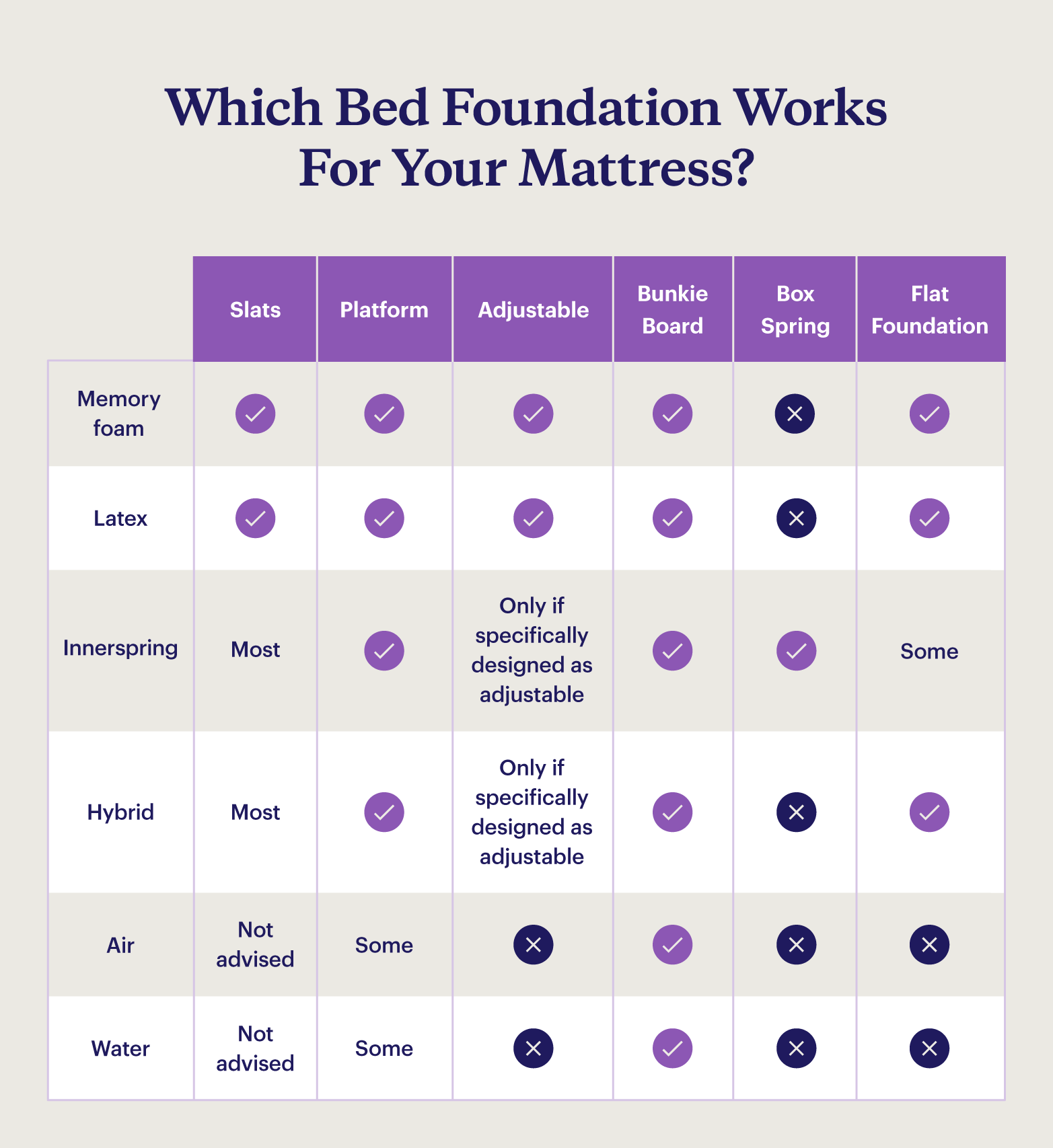
When your bed frame requires supplemental support, select based strictly on mattress type. For traditional innerspring mattresses (8-10 inch profiles with visible coils), a standard box spring provides ideal synergy—the springs compress uniformly with the mattress coils. But for memory foam, latex, or hybrid mattresses, choose a rigid foundation with a solid wood or steel top surface. These provide the motionless base foam needs to maintain its shape.
Critical Foundation Features by Mattress Type
| Mattress Type | Required Support | Minimum Thickness | Key Features to Verify |
|---|---|---|---|
| Memory Foam/Latex | Solid Foundation | 5 inches | Zero flex, <1″ gaps, wood top |
| Hybrid | Foundation or Bunkie Board | 4 inches | Reinforced perimeter, flat top |
| Traditional Innerspring | Box Spring | 8 inches | Intact springs, stable frame |
Bunkie boards (¾-inch plywood boards) solve slat-spacing issues for foam mattresses on slatted frames. Place them directly on the slats—they add just 1 inch of height while creating a rigid surface. Avoid “box spring alternatives” marketed for foam mattresses; most still have unacceptable flex.
Always check your mattress warranty before purchasing support. When in doubt, choose rigid foundations—they work safely with 98% of modern mattresses while protecting your investment. Skip the box spring unless you own a traditional innerspring on a panel frame, and never sacrifice proper support for convenience. Your mattress’s longevity depends on getting this right.


